
Heat-shrink
Heat-shrink is a soft tubing which reduces its original diameter when it's exposed to heat.
The essential key to cable sleeving magic!
In combination with MDPC-X cable sleeving, you will use transparent heat-shrink to fully control the process of melting the sleeve's end on OR to another object, as you can see in our sleeving guide. This magic trick opens endless new possibilities!
Advantages of melting cable sleeve ends
- Extremely robust bond between MDPC-X cable sleeve and connectors, terminals, wire (ends), cable (ends), tubing (ends) etc., which prevents any sliding of the sleeving on the object.
- Maximum kink protection on electrical connections.
- Beautiful and minimalistic sleeve to object transitions.
- In product-design situations where the sleeve is longer than the end of an object, you can fully close the sleeve by melting the sleeve end. You can then cut and file / sand the melted sleeving end for a perfect end section for the object.
Technical info about our heat-shrink: No compromise.
- Among multiple professionals, our heat-shrink has the reputation of being "the best they ever used".
- No thick walls, no double-wall, no glossy surface, no glue, no writings on the surface, no compromise.
- Only high shrink ratios of 4:1 and 3:1
- At ~95°C the heat-shrink will start to shrink.
- It can be exposed 24/7 to temperatures of up to 160°C.
- Without melting or breaking effects, extreme temperatures of 240°C can be applied for a couple of minutes.
- Water in contact with our heat-shrink is not a problem because of the low ~0.25% water absorption property.
- 20KV per mm dielectric strength make our heat-shrink tubing a high class insulation solution.
- Oils, chemicals or cleaning agents have no structural effect on our heat-shrink.
What else can I do with heat-shrink?
- It' used to cover the transition of the sleeve-end to your object
- It's typically used to cover un-insulated sections of bare electrical wire (or wire to crimp terminal transitions).
- It's often used to make a connector to cable (or tubing) transition more robust by being a kink protection.
- In a connector to cable (or tubing) transition it also protects this area against water infiltration.
How to shrink the heat-shrink?
Use a heat-gun (no hair dryer!), lighter, butane torch or
similar. High temperatures (200-300°C) are very efficient.
For lighters / torches, this is the best technique to work with heat shrink:
- Repetitively move the shrink sideways through (into and out) the lower part of the flame. (Why? Above or at the top of a flame could generate soot on the shrink)
- Rotate the heat-shrink to heat it up evenly on all sides.
- Repetitively have a pause of 2-5 seconds after you applied heat to the heat-shrink for ~5 seconds. This prevents breaking / burning of the shrink.
- When the shrinking process is completed, let it cool down before you move, bend or twist anything.
- If you used this technique to also melt the sleeving underneath the heat-shrink, you can now cut off the shrink tube with a scissor or sharp knife.
- If you ever need to soften the heat-shrinks later on, just apply heat again.
"Over-expanding" / Increasing the diameter.
To increase ("over-expand") the original diameter of short heat-shrink pieces to a higher diameter (the minimum diameter will stay the same!), do the following:
- Insert the tips of a straight long nosed plier into the heat-shrink.
- Open the tips of the plier / spread them away from each other. This will stretch / over-expand the heat-shrink from the inside.
- Rotate the heat-shrink to distribute the stretch forces over different parts of the surface. This will avoid braking of the heat-shrink during the stretching or shrinking process.


Splicing Solder-Shrink
Splicing Solder-Shrink is a solution for making Y-wire splits without owning a soldering iron. Problem:Especially when working on PC power supplies, you encounter so called "double wires". Two wires from the PSU end in one crimp terminal on the connector for devices like 24-pin ATX, PCI-E or others. To sleeve these stock double wires is mostly impossible or just too ugly. Solution:The best way to solve these problems is the so called "wire splicing method". Instead of keeping the described double-wire, you create a Y-wire split, which has the same functionality. 2 short pieces of wire (close to the PSU) are soldered together with 1 single long wire, creating a Y-wire split. All 3 wires can then be sleeved too. You will usually need a soldering iron, but if you don't own one, you can use the Splicing Solder-Shrink. Usage of Splicing Solder-Shrink: You must own a heatgun. Other methods will be too complicated / will often not work. The Splicing Solder-Shrink is a heatshrink, which includes a ring of solder on the center, inside the shrink. It also includes 2 blue glue rings, which additionally fix the wires inside. 2 unsleeved wires of up to 2.5mm (like our 15AWG wire) outer diameter each (a 5mm OD in total) can be inserted on one side. 1 wire of up to 2.5mm OD + sleeving (SMALL or XTC) can be inserted on the other side, sleeving underneath the glue ring too. The wires should be stripped at a length of 7mm to 10mm before inserting them from both ends, all overlapping each other underneath the solder ring. You can then quickly fix the 3 wires by heating up the heatshrink a little bit. To make the solder melt, you should apply at least 300°C (400°C is also fine) for at least 15 seconds to the solder ring. You will see once it reacts after some first experiences and practice. Once the solder ring is gone (!), as shown on the photos, you are done. Have a look at the photos for further details and ideas. You could also cut away the blue glue rings before doing this all. Without the glue rings, you could also cut away the complete shrink after the solder processing is completed.

Black Heatshrink 4:1 MICRO
30 cm (1 ft) of MDPC Heatshrink 4:1 MICRO Black. Before shrinking it has an initial diameter of 4.0 mm and goes down to 1.0 mm after shrinking. This MICRO heatshrink is used for special applications where SMALL size would already be too big. Featuring a very beautiful, dark, smooth and matte surface, extreme overexpansion capabilities allow for even bigger initial object diameters. With a long nosed plier inserted into the heatshrink to widen the inner diameter, you can easily and safely reach an ID of 5.5 mm - resulting in a shrink ratio of almost 5.5:1! Enjoy a class of its own when it comes to heatshrink. This heat-shrink has a dielectric strength of 22 kV/mm and an initial shrink temperature (Min) of only 90°C. The constant operating range at temperatures from -60°C to +140°C allows it to be used safely in many environments. Its extremely good short term resistance to fire is especially important for the “shrinkless” melting technique. Enjoy a class of its own when it comes to heat-shrink.
Content: 0.3 meter (€3.30 / 1 meter)
Black Heatshrink 4:1 MICRO 200m
200 meters (660 ft) of MDPC Heatshrink 4:1 MICRO Black. Before shrinking it has an initial diameter of 4.0 mm and goes down to 1.0 mm after shrinking. For more info, please read the product description of the small quantity offering of this product.
Content: 200 meter (€1.07 / 1 meter)

Clear Heatshrink 3:1 MICRO
30 cm (1 ft) of MDPC Heatshrink 3:1 MICRO Clear. Before shrinking it has an initial diameter of 4.5 mm and goes down to 1.5 mm after shrinking. This MICRO heatshrink is used for special applications where SMALL size would already be too big. It is especially useful for a controlled melting of the sleeving inside the heatshrink, because you have a clear view on what's happening. Featuring extreme overexpansion capabilities allow for even bigger initial object diameters. With a long nosed plier inserted into the heatshrink to widen the inner diameter, you can easily and safely reach an ID of 8.0 mm - resulting in a shrink ratio of almost 5.5:1! Enjoy a class of its own when it comes to heatshrink. This heat-shrink has a dielectric strength of 22 kV/mm and an initial shrink temperature (Min) of only 90°C. The constant operating range at temperatures from -60°C to +140°C allows it to be used safely in many environments. Its extremely good short term resistance to fire is especially important for the “shrinkless” melting technique. Enjoy a class of its own when it comes to heat-shrink.
Content: 0.3 meter (€2.83 / 1 meter)
Clear Heatshrink 3:1 MICRO 100m
100 meters (330 ft) of MDPC Heatshrink 3:1 MICRO Clear. Before shrinking it has an initial diameter of 4.5 mm and goes down to 1.5 mm after shrinking. For more info, please read the product description of the small quantity offering of this product.
Content: 100 meter (€0.82 / 1 meter)

Black Heat-Shrink 3:1 SMALL
30 cm (1 ft) of MDPC Heat-Shrink 3.25:1 Black. Before shrinking it has an initial diameter of 6.2 mm and goes down to 1.9 mm after shrinking.If you need larger quantities of Black heat-shrink SMALL, please use the separate offering in the heatshrink SMALL Spools category. This heatshrink covers the typical application range for MDPC-X SMALL and XTC cable sleeving. You can easily put it over the sleeving without any fiddling and then shrink it down to the typical wire sizes used for cable-sleeving. Featuring a very beautiful, dark, smooth and matte surface, extreme overexpansion capabilities allow for even bigger initial object diameters. With a long nosed plier inserted into the heatshrink to widen the inner diameter, you can easily and safely reach an ID of 9.0 mm - resulting in a shrink ratio of almost 5:1! Enjoy a class of its own when it comes to heatshrink. This heat-shrink has a dielectric strength of 22 kV/mm and an initial shrink temperature (Min) of only 90°C. The constant operating range at temperatures from -60°C to +140°C allows it to be used safely in many environments. Its extremely good short term resistance to fire is especially important for the “shrinkless” melting technique. Enjoy a class of its own when it comes to heat-shrink.
Content: 0.3 meter (€2.83 / 1 meter)

Black Heat-Shrink 3:1 SMALL 100m
100 meters (~330 ft) of black heatshrink with a 3.25:1 shrink ratio (before shrinking 6.2 mm / 1.9 mm after shrinking). This heatshrink covers the typical application range for MDPC-X SMALL and XTC cable sleeving. You can easily put it over the sleeving without any fiddling and then shrink it down to the typical wire sizes used for cable-sleeving. Featuring a very beautiful, dark, smooth and matte surface, extreme overexpansion capabilities allow for even bigger initial object diameters. With a long nosed plier inserted into the heatshrink to widen the inner diameter, you can easily and safely reach an ID of 9.0 mm - resulting in a shrink ratio of almost 5:1! Enjoy a class of its own when it comes to heatshrink.
Content: 100 meter (€1.12 / 1 meter)

Clear Heat-Shrink 4:1 SMALL
30 cm (1 ft) of Clear / Transparent heatshrink tubing SMALL with a 4.35:1 shrink ratio (before shrinking 6.5 mm / 1.5 mm after shrinking).If you need larger quantities of Clear / Transparent heatshrink SMALL, please use the separate offering in the heatshrink SMALL spools category. This is - very likely - the best heatshrink in existence for the purpose of making custom cables with cable sleeving. This extremely transparent heatshrink is ideal for controlled "melting of cable sleeving underneath heatshrink" techniques and covers the typical application range for MDPC-X SMALL and XTC cable sleeving. The heatshrink surface has lots of grip on an object. You can easily put it over the sleeving without any fiddling and then shrink it down to the typical wire sizes used for cable-sleeving. Featuring extreme overexpansion capabilities, this heatshrink allows for even bigger initial object diameters. With a long nosed plier inserted into the heatshrink to widen the inner diameter, you can easily and safely reach an ID of 9.0 mm - resulting in a shrink ratio of almost 6:1! Enjoy a class of its own when it comes to heatshrink. The sum of its properties makes the whole sleeving process as easy as never before: 4,35:1 shrink ratio. Over-expanded you can reach a 6:1 shrink ratio. See the cable sleeve through the heat-shrink for a 100% precise positioning of the sleeving. See the melting process of the cable sleeving through the heat-shrink while doing the “shrinkless method”. Extremely soft material for the most extreme grip on wires and cable sleeve without the use of glue. Ultra-thin material (0.2 mm at initial diameter) combined with extreme transparency, almost invisible on top of cable sleeving. Dielectric strength of 22 kV/mm. Shrink temperature (Min) of only 90°C. Constant operating range at temperatures from -60°C to +140°C. Extremely good short term resistance to fire, especially important for the “shrinkless” melting technique.
Content: 0.3 meter (€2.83 / 1 meter)

Clear Heat-Shrink 4:1 SMALL 100m
100 meters (~330 ft) of Clear / Transparent heatshrink tubing SMALL with a 4.35:1 shrink ratio (before shrinking 6.5 mm / 1.5 mm after shrinking). This is - very likely - the best heatshrink in existence for the purpose of making custom cables with cable sleeving. This extremely transparent heatshrink is ideal for controlled "melting of cable sleeving underneath heatshrink" techniques and covers the typical application range for MDPC-X SMALL and XTC cable sleeving. The heatshrink surface has lots of grip on an object. You can easily put it over the sleeving without any fiddling and then shrink it down to the typical wire sizes used for cable-sleeving. Featuring extreme overexpansion capabilities, this heatshrink allows for even bigger initial object diameters. With a long nosed plier inserted into the heatshrink to widen the inner diameter, you can easily and safely reach an ID of 9.0 mm - resulting in a shrink ratio of almost 6:1! Enjoy a class of its own when it comes to heatshrink. The sum of its properties makes the whole sleeving process as easy as never before: 4,35:1 shrink ratio. Over-expanded you can reach a 6:1 shrink ratio. See the cable sleeve through the heat-shrink for a 100% precise positioning of the sleeving. See the melting process of the cable sleeving through the heat-shrink while doing the “shrinkless method”. Extremely soft material for the most extreme grip on wires and cable sleeve without the use of glue. Ultra-thin material (0.2 mm at initial diameter) combined with extreme transparency, almost invisible on top of cable sleeving. Dielectric strength of 22 kV/mm. Shrink temperature (Min) of only 90°C. Constant operating range at temperatures from -60°C to +140°C. Extremely good short term resistance to fire, especially important for the “shrinkless” melting technique.
Content: 100 meter (€1.50 / 1 meter)

White Heat-Shrink 3:1 SMALL
30 cm (1 ft) of White heatshrink tubing SMALL with a 3:1 shrink ratio (before shrinking 6.2 mm / 2.0 mm after shrinking).If you need larger quantities of White heatshrink SMALL, please use the separate offering in the heatshrink SMALL spools category. This beautiful bright white heatshrink covers the typical application range for MDPC-X SMALL and XTC cable sleeving. You can easily put it over the sleeving without any fiddling and then shrink it down to the typical wire sizes used for cable-sleeving. Featuring safe overexpansion capabilities, this heatshrink allows for even bigger initial object diameters. With a long nosed plier inserted into the heatshrink to widen the inner diameter, you can easily and safely reach an ID of 9.0 mm - resulting in a shrink ratio of almost 4.5:1! The sum of its properties makes the whole sleeving process very easy: 3:1 shrink ratio. Over-expanded you can reach a 4.5:1 shrink ratio. Dielectric strength of 22 kV/mm. Shrink temperature (Min) of only 90°C. Constant operating range at temperatures from -60°C to +140°C. Extremely good short term resistance to fire.
Content: 0.3 meter (€2.83 / 1 meter)

White Heatshrink 3:1 SMALL 100m
100 meters (~330 ft) of White heatshrink tubing SMALL with a 3:1 shrink ratio (before shrinking 6.2 mm / 2.0 mm after shrinking). This beautiful bright white heatshrink covers the typical application range for MDPC-X SMALL and XTC cable sleeving. You can easily put it over the sleeving without any fiddling and then shrink it down to the typical wire sizes used for cable-sleeving. Featuring safe overexpansion capabilities, this heatshrink allows for even bigger initial object diameters. With a long nosed plier inserted into the heatshrink to widen the inner diameter, you can easily and safely reach an ID of 9.0 mm - resulting in a shrink ratio of almost 4.5:1! The sum of its properties makes the whole sleeving process very easy: 3:1 shrink ratio. Over-expanded you can reach a 4.5:1 shrink ratio. Dielectric strength of 22 kV/mm. Shrink temperature (Min) of only 90°C. Constant operating range at temperatures from -60°C to +140°C. Extremely good short term resistance to fire.
Content: 100 meter (€1.12 / 1 meter)
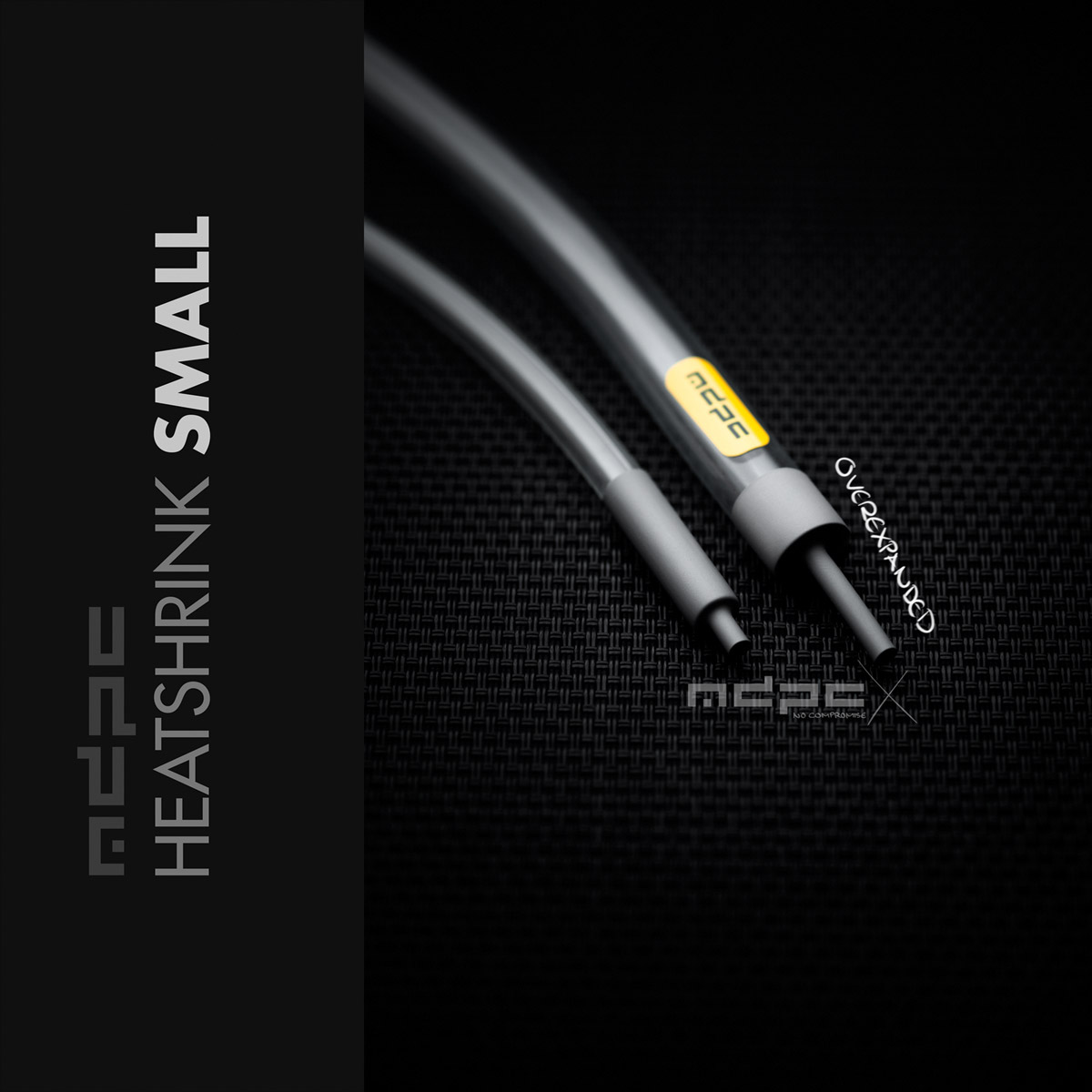
Grey Heat-Shrink 3:1 SMALL
Heatshrink has never looked that good before! Enjoy this medium grey shade with a beautiful smooth and matte surface, extra thin walls and extreme overexpansion (5:1) capabilities. 30 cm (1 ft) of MDPC Heat-Shrink 3.3:1 Grey. Before shrinking it has an initial diameter of 6.4 mm and goes down to 1.9 mm after shrinking.If you need larger quantities of Grey heat-shrink SMALL, please use the separate offering in the heatshrink SMALL Spools category. This heatshrink covers the typical application range for MDPC-X SMALL and XTC cable sleeving. You can easily put it over the sleeving without any fiddling and then shrink it down to the typical wire sizes used for cable-sleeving. With a long nosed plier inserted into the heatshrink to widen (overexpand) the inner diameter, you can easily and safely reach an ID of 10.0 mm - resulting in a shrink ratio of almost 5:1! Enjoy a class of its own when it comes to heatshrink. This heat-shrink has a dielectric strength of 22 kV/mm and an initial shrink temperature (Min) of only 90°C. The constant operating range at temperatures from -60°C to +140°C allows it to be used safely in many environments. Its extremely good short term resistance to fire is especially important for the “shrinkless” melting technique. Enjoy a class of its own when it comes to heat-shrink.
Content: 0.3 meter (€2.83 / 1 meter)

Grey Heat-Shrink 3:1 SMALL 100m
100 meters (~330 ft) of grey heatshrink with a 3.3:1 shrink ratio (before shrinking 6.4 mm / 1.9 mm after shrinking). This heatshrink covers the typical application range for MDPC-X SMALL and XTC cable sleeving. You can easily put it over the sleeving without any fiddling and then shrink it down to the typical wire sizes used for cable-sleeving. With a long nosed plier inserted into the heatshrink to widen the inner diameter, you can easily and safely reach an ID of 10.0 mm - resulting in a shrink ratio of almost 5:1! Enjoy a class of its own when it comes to heatshrink.
Content: 100 meter (€1.12 / 1 meter)

Blue Heat-Shrink 4:1 SMALL
30 cm (1 ft) of MDPC Blue heat-shrink tubing 4:1 SMALL.If you need larger quantities of Blue heat-shrink SMALL, please use the separate offering in the heat-shrink SMALL Spools category. Details about the specific "SMALL" 4:1 heat-shrink properties, you find in the HEATSHRINK 4:1 SMALL category description. A full description of the general properties, features and advantages of our MDPC heat-shrink tubing products, you find in the HEATSHRINK category description.
Content: 0.3 meter (€3.30 / 1 meter)
Blue Heatshrink 4:1 SMALL 150m
MDPC Blue heatshrink tubing 4:1 SMALL, 150 meters (~492 feet) Details about the specific "SMALL" 4:1 heat shrink properties, you find in the HEATSHRINK 4:1 SMALL category description. A full description of the general properties, features and advantages of our MDPC heat shrink tubing products, you find in the HEATSHRINK category description.

White PRE-CUT Heatshrink SMALL 100x
100x White pre-cut heatshrink with a 3:1 shrink ratio (before shrinking 6.2 mm / 2.0 mm after shrinking): The length of each pre-cut heatshrink is 15 mm. This package includes 100 pieces (15 mm x 100 pieces = 1.5 meters). This beautiful bright white pre-cut heatshrink of 15mm length covers the typical application range for MDPC-X SMALL and XTC cable sleeving. You can easily put it over the sleeving without any fiddling and then shrink it down to the typical wire sizes used for cable-sleeving. Featuring safe overexpansion capabilities, this heatshrink allows for even bigger initial object diameters. With a long nosed plier inserted into the heatshrink to widen the inner diameter, you can easily and safely reach an ID of 9.0 mm - resulting in a shrink ratio of almost 4.5:1! The sum of its properties makes the whole sleeving process very easy: 3:1 shrink ratio. Over-expanded you can reach a 4.5:1 shrink ratio. Dielectric strength of 22 kV/mm. Shrink temperature (Min) of only 90°C. Constant operating range at temperatures from -60°C to +140°C. Extremely good short term resistance to fire.
Content: 100 piece (€0.06 / 1 piece)

Light-Red PRE-CUT Heatshrink SMALL 100x
This package includes 100 pieces MDPC SMALL Light-Red pre-cut heatshrink tubing 4:1 of 15 mm length. Details about the specific "SMALL" 4:1 heatshrink properties, you find in the HEATSHRINK 4:1 SMALL category description. A full description of the general properties, features and advantages of our MDPC heat shrink tubing products, you find in the HEATSHRINK category description.
Content: 100 piece (€0.06 / 1 piece)

Blue PRE-CUT Heatshrink SMALL 100x
This package includes 100 pieces MDPC SMALL Blue pre-cut heatshrink tubing 4:1 of 15 mm length. Details about the specific "SMALL" 4:1 heatshrink properties, you find in the HEATSHRINK 4:1 SMALL category description. A full description of the general properties, features and advantages of our MDPC heat shrink tubing products, you find in the HEATSHRINK category description.
Content: 100 piece (€0.06 / 1 piece)

Green PRE-CUT Heatshrink SMALL 100x
This package includes 100 pieces MDPC SMALL Green pre-cut heatshrink tubing 4:1 of 15 mm length. Details about the specific "SMALL" 4:1 heatshrink properties, you find in the HEATSHRINK 4:1 SMALL category description. A full description of the general properties, features and advantages of our MDPC heat shrink tubing products, you find in the HEATSHRINK category description.
Content: 100 piece (€0.06 / 1 piece)

Yellow PRE-CUT Heatshrink SMALL 100x
This package includes 100 pieces MDPC SMALL Yellow pre-cut heatshrink tubing 4:1 of 15 mm length. Details about the specific "SMALL" 4:1 heatshrink properties, you find in the HEATSHRINK 4:1 SMALL category description. A full description of the general properties, features and advantages of our MDPC heat shrink tubing products, you find in the HEATSHRINK category description.
Content: 100 piece (€0.06 / 1 piece)

Black Heatshrink 4:1 SMALL PLUS
30 cm (1 ft) of Black heatshrink tubing SMALL PLUS with a 4.5:1 shrink ratio (before shrinking 9.0 mm / 2.0 mm after shrinking).If you need larger quantities of Black heatshrink SMALL PLUS, please use the separate offering in the heatshrink SMALL PLUS spools category. This beautiful matte black heatshrink covers a wide application range. Featuring safe overexpansion capabilities, this heatshrink allows for even bigger initial object diameters. With a long nosed plier inserted into the heatshrink to widen the inner diameter, you can easily and safely reach an ID of 11.0 mm - resulting in a shrink ratio of almost 5.5:1! The sum of its properties makes the whole sleeving process very easy: 4.5:1 shrink ratio. Over-expanded you can reach a 5.5:1 shrink ratio. Wall thickness of only 0.25 mm at initial state. Dielectric strength of 22 kV/mm. Shrink temperature (Min) of only 90°C. Constant operating range at temperatures from -60°C to +140°C. Extremely good short term resistance to fire.
Content: 0.3 meter (€3.67 / 1 meter)
Black Heatshrink 4:1 SMALL PLUS 100m
100 meters (~330 ft) of Black heatshrink tubing SMALL PLUS with a 4.5:1 shrink ratio (before shrinking 9.0 mm / 2.0 mm after shrinking). Read more about this product in the description of the smaller quantity offering.
Content: 100 meter (€1.77 / 1 meter)

White Heatshrink 4:1 SMALL PLUS
30 cm (1 ft) of White heatshrink tubing SMALL PLUS with a 4.5:1 shrink ratio (before shrinking 9.0 mm / 2.0 mm after shrinking).If you need larger quantities of White heatshrink SMALL PLUS, please use the separate offering in the heatshrink SMALL PLUS spools category. This beautiful bright white heatshrink covers a wide application range. Featuring safe overexpansion capabilities, this heatshrink allows for even bigger initial object diameters. With a long nosed plier inserted into the heatshrink to widen the inner diameter, you can easily and safely reach an ID of 11.0 mm - resulting in a shrink ratio of almost 5.5:1! The sum of its properties makes the whole sleeving process very easy: 4.5:1 shrink ratio. Over-expanded you can reach a 5.5:1 shrink ratio. Wall thickness of only 0.25 mm at initial state. Dielectric strength of 22 kV/mm. Shrink temperature (Min) of only 90°C. Constant operating range at temperatures from -60°C to +140°C. Extremely good short term resistance to fire.
Content: 0.3 meter (€3.67 / 1 meter)
White Heatshrink 4:1 SMALL PLUS 100m
100 meters (~330 ft) of White heatshrink tubing SMALL PLUS with a 4.5:1 shrink ratio (before shrinking 9.0 mm / 2.0 mm after shrinking). Read more about this product in the description of the smaller quantity offering.
Content: 100 meter (€1.98 / 1 meter)

Black Heat-Shrink 4:1 MEDIUM
30 cm (1 ft) of Black heat-shrink 4:1 MEDIUM by MDPC-X. If you need larger quantities of Black heat-shrink 4:1 MEDIUM, please use the separate offering in the heat-shrink 4:1 MEDIUM Spools category. Here we go with the next generation of our heat-shrink. 4:1 shrink ratio (of course without glue or dual wall!), going from 13.8 mm ID down to 3.5 mm, ultra thin wall with a 0.25 mm thickness at initial ID and an extreme resistance to fire. The new matte surface of this heatshrink is extremely beautiful and smooth. 4:1 shrink ratio. Initial 13.8 mm ID for total clearance when moving the heat-shrink over many connectors and the cable sleeving in every situation. Shrinking down to 3.5 mm for maximum grip and compression on the cable and sleeving. Ultra-thin material (0.25 mm at initial diameter) combined with a beautiful matte and smooth surface. Dielectric strength of 22 kV/mm. Shrink temperature (Min) of only 90°C. Constant operating range at temperatures from -60°C to +140°C. Extremely good short term resistance to fire, especially important for the “shrinkless” melting technique. Made in Germany only for MDPC-X. Globally unique product in a class of its own.
Content: 0.3 meter (€3.83 / 1 meter)
Black Heat-Shrink 4:1 MEDIUM 100m
Black Heat-Shrink 4:1 MEDIUM 100 meters (330 ft) on a spool. Read more about the properties of this heat-shrink, by reading the description of the smaller quantity offering of Black Heat-Shrink 4:1 MEDIUM.
Content: 100 meter (€1.72 / 1 meter)

Transparent Heat-Shrink 4:1 MEDIUM
30 cm (1 ft) of Transparent heat-shrink 4:1 MEDIUM by MDPC-X. If you need larger quantities of Transparent heat-shrink 4:1 MEDIUM, please use the separate offering in the heat-shrink 4:1 MEDIUM Spools category. Here we go with the next generation of our heat-shrink. Extreme grip without glue, 4:1 shrink ratio, going from 13.8 mm ID down to 3.5 mm. Extreme resistance to fire. Melt together your connector plastic and cable sleeving... and take it off, or just use it traditionally as an almost invisible heat shrink with its 0.25 mm thickness at initial ID. 4:1 shrink ratio. Initial 13.8 mm ID for total clearance when moving the heat-shrink over many connectors and the cable sleeving in every situation. Shrinking down to 3.5 mm for maximum grip and compression on the cable and sleeving. See the cable sleeve through the heat-shrink for a 100% precise positioning of the sleeving. See the melting process of the cable sleeving through the heat-shrink while doing the “shrinkless method”. With some practice, you can often melt together the connector plastic material with the cable sleeving. Extremely soft material for the most extreme grip on wires and cable sleeve without the use of glue. Ultra-thin material (0.25 mm at initial diameter) combined with extreme transparency, almost invisible on top of cable sleeving. Dielectric strength of 22 kV/mm. Shrink temperature (Min) of only 90°C. Constant operating range at temperatures from -60°C to +140°C. Extremely good short term resistance to fire, especially important for the “shrinkless” melting technique. Made in Germany only for MDPC-X. Globally unique product in a class of its own.
Content: 0.3 meter (€3.83 / 1 meter)
Transparent Heat-Shrink 4:1 MEDIUM 100m
Transparent Heat-Shrink 4:1 MEDIUM 100 meters (330 ft) on a spool. Read more about the properties of this heat-shrink, by reading the description of the smaller quantity offering of Transparent Heat-Shrink 4:1 MEDIUM.
Content: 100 meter (€1.89 / 1 meter)

White Heat-Shrink 3.4:1 MEDIUM
30 cm (1 ft) of MDPC White heat-shrink tubing 3.4:1 MEDIUM. 3:1 shrink ratio (of course without glue or dual wall!), going from 13 mm ID down to 4 mm, ultra thin wall with a 0.25 mm thickness at initial ID and an extreme resistance to fire. 3:1 shrink ratio. Initial 13 mm ID for total clearance when moving the heat-shrink over many connectors and the cable sleeving in every situation. Shrinking down to 4 mm for maximum grip and compression on the cable and sleeving. Ultra-thin material (0.25 mm at initial diameter). Dielectric strength of 22 kV/mm. Shrink temperature (Min) of only 90°C. Constant operating range at temperatures from -60°C to +140°C. Extremely good short term resistance to fire, especially important for the “shrinkless” melting technique. Made in Germany only for MDPC-X. Globally unique product in a class of its own.
Content: 0.3 meter (€3.83 / 1 meter)

Grey Heat-Shrink 3.4:1 MEDIUM
30 cm (1 ft) of MDPC Grey heat-shrink tubing 3.4:1 MEDIUM. 3.4:1 shrink ratio (of course without glue or dual wall!), going from 13 mm ID down to 4 mm, ultra thin wall with a 0.25 mm thickness at initial ID and an extreme resistance to fire. The heatshrink can be easily overexpanded to an initial diameter of 15 mm by using a long-nosed-plier, resulting in a shrink ratio of almost 4:1. 3.4:1 shrink ratio. Initial 13 mm ID for total clearance when moving the heat-shrink over many connectors and the cable sleeving in every situation. Shrinking down to 4 mm for maximum grip and compression on the cable and sleeving. Ultra-thin material (0.25 mm at initial diameter). Dielectric strength of 22 kV/mm. Shrink temperature (Min) of only 90°C. Constant operating range at temperatures from -60°C to +140°C. Extremely good short term resistance to fire, especially important for the “shrinkless” melting technique. Made in Germany only for MDPC-X. Globally unique product in a class of its own.
Content: 0.3 meter (€3.80 / 1 meter)
Grey Heat-Shrink 4:1 MEDIUM 100m
Grey Heat-Shrink 4:1 MEDIUM 100 meters (330 ft) on a spool. Read more about the properties of this heat-shrink, by reading the description of the smaller quantity offering of Grey Heat-Shrink 4:1 MEDIUM.
Content: 100 meter (€1.89 / 1 meter)

Light-Red Heat-Shrink 3.4:1 MEDIUM
30 cm (1 ft) of MDPC Light-Red heat-shrink tubing 3.4:1 MEDIUM. 3:1 shrink ratio (of course without glue or dual wall!), going from 13 mm ID down to 4 mm, ultra thin wall with a 0.25 mm thickness at initial ID and an extreme resistance to fire. 3:1 shrink ratio. Initial 13 mm ID for total clearance when moving the heat-shrink over many connectors and the cable sleeving in every situation. Shrinking down to 4 mm for maximum grip and compression on the cable and sleeving. Ultra-thin material (0.25 mm at initial diameter). Dielectric strength of 22 kV/mm. Shrink temperature (Min) of only 90°C. Constant operating range at temperatures from -60°C to +140°C. Extremely good short term resistance to fire, especially important for the “shrinkless” melting technique. Made in Germany only for MDPC-X. Globally unique product in a class of its own.
Content: 0.3 meter (€3.83 / 1 meter)
Light-Red Heat-Shrink 3.4:1 MEDIUM 100m
MDPC Light Red heat shrink tubing 3.4:1 SATA, 100 meters (~330 feet) 3:1 shrink ratio (of course without glue or dual wall!), going from 13 mm ID down to 4 mm, ultra thin wall with a 0.25 mm thickness at initial ID and an extreme resistance to fire. 3:1 shrink ratio. Initial 13 mm ID for total clearance when moving the heat-shrink over many connectors and the cable sleeving in every situation. Shrinking down to 4 mm for maximum grip and compression on the cable and sleeving. Ultra-thin material (0.25 mm at initial diameter). Dielectric strength of 22 kV/mm. Shrink temperature (Min) of only 90°C. Constant operating range at temperatures from -60°C to +140°C. Extremely good short term resistance to fire, especially important for the “shrinkless” melting technique. Made in Germany only for MDPC-X. Globally unique product in a class of its own.
Content: 100 meter (€1.89 / 1 meter)

Blue Heat-Shrink 3.4:1 MEDIUM
30 cm (1 ft) of MDPC Blue heat-shrink tubing 3.4:1 MEDIUM. 3:1 shrink ratio (of course without glue or dual wall!), going from 13 mm ID down to 4 mm, ultra thin wall with a 0.25 mm thickness at initial ID and an extreme resistance to fire. 3:1 shrink ratio. Initial 13 mm ID for total clearance when moving the heat-shrink over many connectors and the cable sleeving in every situation. Shrinking down to 4 mm for maximum grip and compression on the cable and sleeving. Ultra-thin material (0.25 mm at initial diameter). Dielectric strength of 22 kV/mm. Shrink temperature (Min) of only 90°C. Constant operating range at temperatures from -60°C to +140°C. Extremely good short term resistance to fire, especially important for the “shrinkless” melting technique. Made in Germany only for MDPC-X. Globally unique product in a class of its own.
Content: 0.3 meter (€3.83 / 1 meter)
Blue Heatshrink 3.4:1 MEDIUM 100m
MDPC Blue heatshrink tubing 3.4:1 MEDIUM, 100 meters (~330 feet) 3:1 shrink ratio (of course without glue or dual wall!), going from 13 mm ID down to 4 mm, ultra thin wall with a 0.25 mm thickness at initial ID and an extreme resistance to fire. 3:1 shrink ratio. Initial 13 mm ID for total clearance when moving the heat-shrink over many connectors and the cable sleeving in every situation. Shrinking down to 4 mm for maximum grip and compression on the cable and sleeving. Ultra-thin material (0.25 mm at initial diameter). Dielectric strength of 22 kV/mm. Shrink temperature (Min) of only 90°C. Constant operating range at temperatures from -60°C to +140°C. Extremely good short term resistance to fire, especially important for the “shrinkless” melting technique. Made in Germany only for MDPC-X. Globally unique product in a class of its own.
Content: 100 meter (€1.89 / 1 meter)

Green Heat-Shrink 3.4:1 MEDIUM
30 cm (1 ft) of MDPC Green heat-shrink tubing 3.4:1 MEDIUM. 3:1 shrink ratio (of course without glue or dual wall!), going from 13 mm ID down to 4 mm, ultra thin wall with a 0.25 mm thickness at initial ID and an extreme resistance to fire. 3:1 shrink ratio. Initial 13 mm ID for total clearance when moving the heat-shrink over many connectors and the cable sleeving in every situation. Shrinking down to 4 mm for maximum grip and compression on the cable and sleeving. Ultra-thin material (0.25 mm at initial diameter). Dielectric strength of 22 kV/mm. Shrink temperature (Min) of only 90°C. Constant operating range at temperatures from -60°C to +140°C. Extremely good short term resistance to fire, especially important for the “shrinkless” melting technique. Made in Germany only for MDPC-X. Globally unique product in a class of its own.
Content: 0.3 meter (€3.83 / 1 meter)
Green Heathrink 3.4:1 MEDIUM 100m
MDPC Green heatshrink tubing 3.4:1 MEDIUM, 100 meters (~330 feet) 3:1 shrink ratio (of course without glue or dual wall!), going from 13 mm ID down to 4 mm, ultra thin wall with a 0.25 mm thickness at initial ID and an extreme resistance to fire. 3:1 shrink ratio. Initial 13 mm ID for total clearance when moving the heat-shrink over many connectors and the cable sleeving in every situation. Shrinking down to 4 mm for maximum grip and compression on the cable and sleeving. Ultra-thin material (0.25 mm at initial diameter). Dielectric strength of 22 kV/mm. Shrink temperature (Min) of only 90°C. Constant operating range at temperatures from -60°C to +140°C. Extremely good short term resistance to fire, especially important for the “shrinkless” melting technique. Made in Germany only for MDPC-X. Globally unique product in a class of its own.
Content: 100 meter (€1.89 / 1 meter)

Black Heatshrink 4:1 MEDIUM PLUS
30 cm (1 ft) of Black heatshrink tubing MEDIUM PLUS with a 4:1 shrink ratio (before shrinking 16.0 mm / 4.0 mm after shrinking).If you need larger quantities of Black heatshrink MEDIUM PLUS, please use the separate offering in the heatshrink MEDIUM PLUS spools category. This beautiful matte black heatshrink covers a wide application range. Featuring safe overexpansion capabilities, this heatshrink allows for even bigger initial object diameters. With a long nosed plier inserted into the heatshrink to widen the inner diameter, you can easily and safely reach an ID of 20.0 mm - resulting in a shrink ratio of 5:1! The sum of its properties makes the whole sleeving process very easy: 4:1 shrink ratio. Over-expanded you can reach a 5:1 shrink ratio. Wall thickness of only 0.25 mm at initial state. Dielectric strength of 22 kV/mm. Shrink temperature (Min) of only 90°C. Constant operating range at temperatures from -60°C to +140°C. Extremely good short term resistance to fire.
Content: 0.3 meter (€3.83 / 1 meter)
Black Heatshrink 4:1 MEDIUM PLUS 50m
50 meters (~165 ft) of Black heatshrink tubing MEDIUM PLUS with a 4:1 shrink ratio (before shrinking 16.0 mm / 4.0 mm after shrinking). Read more about this product in the description of the smaller quantity offering.
Content: 50 meter (€3.07 / 1 meter)

White Heatshrink 4:1 MEDIUM PLUS
30 cm (1 ft) of White heatshrink tubing MEDIUM PLUS with a 4:1 shrink ratio (before shrinking 16.0 mm / 4.0 mm after shrinking).If you need larger quantities of White heatshrink MEDIUM PLUS, please use the separate offering in the heatshrink MEDIUM PLUS spools category. This beautiful matte white heatshrink covers a wide application range. Featuring safe overexpansion capabilities, this heatshrink allows for even bigger initial object diameters. With a long nosed plier inserted into the heatshrink to widen the inner diameter, you can easily and safely reach an ID of 20.0 mm - resulting in a shrink ratio of 5:1! The sum of its properties makes the whole sleeving process very easy: 4:1 shrink ratio. Over-expanded you can reach a 5:1 shrink ratio. Wall thickness of only 0.25 mm at initial state. Dielectric strength of 22 kV/mm. Shrink temperature (Min) of only 90°C. Constant operating range at temperatures from -60°C to +140°C. Extremely good short term resistance to fire.
Content: 0.3 meter (€3.83 / 1 meter)
White Heatshrink 4:1 MEDIUM PLUS 50m
50 meters (~165 ft) of White heatshrink tubing MEDIUM PLUS with a 4:1 shrink ratio (before shrinking 16.0 mm / 4.0 mm after shrinking). Read more about this product in the description of the smaller quantity offering.
Content: 50 meter (€3.97 / 1 meter)

Anthracite Heat-Shrink 3:1 BIG
20 cm (0.2 meters) of Anthracite Heat-Shrink 3:1 BIGIf you need larger quantities of Anthracite Heat-Shrink 3:1 BIG, please use the separate offering in the Heat-Shrink 3:1 BIG Spools category. Here we go with the next generation of our BIG heat-shrink. Halogen free, 3:1 shrink ratio (of course without glue or dual wall!), going from 25 mm ID down to 8 mm with an extreme resistance to fire. The matte surface of this heat-shrink is extremely beautiful and smooth. The usable range of BIG heat-shrink is exactly the same as the usable range of our BIG cable sleeve. Halogen-free. 3:1 shrink ratio. No glue, no dual wall. Initial 25 mm ID for total clearance when moving the heat-shrink over many connectors and the cable sleeving in every situation. Shrinking down to 8 mm for maximum grip and compression on the cable and sleeving. Beautiful matte and smooth surface. Dielectric strength of 22 kV/mm. Shrink temperature (Min) of only 90°C. Constant operating range at temperatures from -60°C to +140°C. Extremely good short term resistance to fire.
Content: 0.2 meter (€9.85 / 1 meter)
Anthracite Heat-Shrink 3:1 BIG 30m
One spool of 30 meters (~100 feet) Anthracite Heat-Shrink 3:1 BIG. Halogen-free. 3:1 shrink ratio. No glue, no dual wall. Initial 25 mm ID for total clearance when moving the heat-shrink over many connectors and the cable sleeving in every situation. Shrinking down to 8 mm for maximum grip and compression on the cable and sleeving. Beautiful matte and smooth surface. Dielectric strength of 22 kV/mm. Shrink temperature (Min) of only 90°C. Constant operating range at temperatures from -60°C to +140°C. Extremely good short term resistance to fire.
Content: 30 meter (€6.63 / 1 meter)

Transparent Heat-Shrink 3:1 BIG
20 cm (0.2 meters) of Transparent Heat-Shrink 3:1 BIGIf you need larger quantities of Transparent Heat-Shrink 3:1 BIG, please use the separate offering in the Heat-Shrink 3:1 BIG Spools category. Here we go with the next generation of our BIG heat-shrink. Halogen free, 3:1 shrink ratio (of course without glue or dual wall!), going from 25 mm ID down to 8 mm with an extreme resistance to fire. The extremely transparent material of this 3:1 heat-shrink provides extreme grip. The photo shows a black MDPC sticker underneath the heat-shrink to demonstrate the transparency. The usable range of BIG heat-shrink is exactly the same as the usable range of our BIG cable sleeve. Halogen-free. 3:1 shrink ratio. No glue, no dual wall. Initial 25 mm ID for total clearance when moving the heat-shrink over many connectors and the cable sleeving in every situation. Shrinking down to 8 mm for maximum grip and compression on the cable and sleeving. Extreme transparency and very high grip. Dielectric strength of 22 kV/mm. Shrink temperature (Min) of only 90°C. Constant operating range at temperatures from -60°C to +140°C. Extremely good short term resistance to fire.
Content: 0.2 meter (€9.85 / 1 meter)
Transparent Heat-Shrink 3:1 BIG 30m
One spool of 30 meters (~100 feet) Transparent Heat-Shrink 3:1 BIG. Halogen-free. 3:1 shrink ratio. No glue, no dual wall. Initial 25 mm ID for total clearance when moving the heat-shrink over many connectors and the cable sleeving in every situation. Shrinking down to 8 mm for maximum grip and compression on the cable and sleeving. Extreme transparency and maximum grip. Dielectric strength of 22 kV/mm. Shrink temperature (Min) of only 90°C. Constant operating range at temperatures from -60°C to +140°C. Extremely good short term resistance to fire.
Content: 30 meter (€6.98 / 1 meter)